

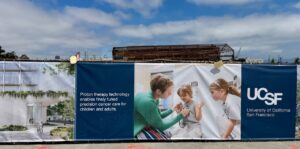
In Part 1 of this Q & A series, UCSF Radiation Oncology Department Chair Catherine Park, MD, shares insights on Proton Therapy and Clinical Impact once the building is completed at the Dogpatch Powerstation. Part 2 will address Research Innovation. Photo above by Henrik Kam photography.
Vision & Strategic Importance

Catherine Park, MD, Chair of the UCSF Department of Radiation Oncology
Q: UCSF has been working toward proton therapy for years. What does this milestone mean for the institution and for cancer care in Northern California?
A: This milestone means that UCSF will have the ability to provide state of the art proton therapy technology for the treatment and cure of many cancers, and spare sometimes lifelong side effects to normal tissue organs. It will also mean that patients and families who currently travel to seek this therapy will be able to stay within their communities and local geographies to access care. It also means that a potent tool will be available to the most innovative and impactful basic/translational and clinical researchers at UCSF and in our local academic communities to discover new treatment paradigms and cures. Importantly, it will provide access to long awaited cancer therapy to patients throughout the Bay area and beyond.
Q: Why now, and why UCSF?
A: Proton and particle therapy has its roots in the Bay area at the Lawrence Berkeley National Lab in the 1960’s. The technology was commercialized in the early 2000’s and development continued steadily over the past decades. These systems are orders of magnitude larger in size than typical linear accelerator footprints and require large and complex construction. Each project is a feat of engineering, design and project management and requires highly specialized technical and clinical expertise to run. Today, the technology has matured to include several important features to enable more accurately targeted treatments. It has taken many years to realize the dream and vision to finally acquire proton therapy for cancer patients at UCSF.
Q: How does proton therapy fit into UCSF’s broader vision of “bench-to-bedside” cancer care?
A: We have learned that due to the physical properties of proton therapy, it will fundamentally decrease radiation dose to critical organs, especially in children. It will also be instrumental in treatments for brain, spine, head and neck and several other cancers for the same reasons. However, there is still much to learn about the biological effects of proton therapy on cancers and normal tissues, and exciting opportunities in pre-clinical research to further investigate how to improve efficacy of treatment.
 Q: What differentiates UCSF’s approach compared to other academic centers?
A: Proton therapy centers are relatively few, and thus collaborations are incredibly important in this super-specialized field. However, UCSF has particular opportunities by virtue of the deep scientific expertise across multiple outstanding cancer researchers and programs. In radiation oncology, we will be building upon important areas of biology/translation in effects on the tumor microenvironment, including immune modulatory agents, prediction using imaging science, computational modeling and advanced personalized dose-calculations in addition to robust clinical trials.
Q: The new facility is part of the Dogpatch Power Station redevelopment. How does that location shape the program’s clinical and research mission?
A: This location is ideal for a ground up construction of a proton therapy center—and it’s juxtaposition with the Mission Bay campus allows easy access for our cancer clinics as well as major research footprint.
Clinical Impact of Proton Therapy
Q: For a general audience, how would you explain the key clinical advantages of proton therapy over conventional radiation?
A: The clinical advantages of proton therapy stem from its physical properties—a colleague once described it as a baseball—it’s a fast-moving mass that can hit a target but then it deposits its energy all at once and falls. Because of this, we can direct proton therapy to certain depths in the body, and it can deposit the therapeutic energy at that precise spot and stop. So while there is dose along the path of travel, it is much lower than where it lands and there it does not keep traveling to expose any more tissue. In contrast, conventional radiation uses high energy xrays which travel through the body even after hitting its target—because of this, there are less ways to decrease dose to normal tissues that surround the cancer.
Q: Which patient populations stand to benefit the most?
The patients who will benefit most are children, since we know any exposure to toxic therapy can have a more profound effect on developing organs. Proton therapy will have a clearer advantage over xrays in cancers where there are critical organs in the immediate vicinity, such as in the brain, head and neck and spine. Many cancer treatments will have a decrease normal organ exposure with proton over xray therapy, however, the ability to do large scale trials across many disease sites is limited by the relatively few proton therapy centers that exist.
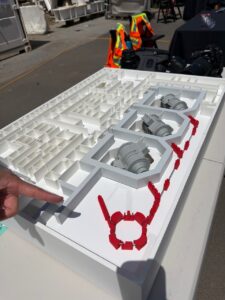
Model of Proton Therapy Cancer care center – 3 gantries on right
Q: Proton therapy is often described as more precise. How does that translate into real-world patient outcomes—both in cure rates and quality of life?
Proton therapy is more precise because the size of the beams is on a smaller scale than xray therapy. But its ability to avoid normal tissues is due to its physical properties—so this means young children who need cranio-spinal radiation will not have dose travel through their lung and heart, reducing the risk for lasting damage and second cancers. Another example is patients with head and neck cancers—it is more feasible to spare their salivary glands which can lead to a life long preservation of ability to swallow/eat and speak over their lifetimes. These are really profound to a patient’s quality of life.
Read Part 2 of this Q & A Series on “Research and Innovation,” and “The Big Picture” coming soon!