

In Part 2 of this Q & A series, UCSF Radiation Oncology Department Chair Catherine Park, MD, shares insights on Proton Therapy Research and Innovation. Also, read Q & A: Bringing Proton Therapy to UCSF—A New Era for Cancer Care and Discovery, Part 1
Q: Beyond clinical care, UCSF has emphasized that this will be a “center of excellence.” What are the top research priorities for the proton therapy program?
A: We envision that our center will facilitate opportunities for discovery and innovation in particle therapy radiobiology, physics and clinical trials. In addition to opening novel trials that will test the outcomes of proton therapy both alone and in combination with targeted agents, we will be designing a clinical infrastructure that allows us to learn from every patient by prospectively capturing the most relevant data from their treatment. We have also planned and will build the research infrastructure needed to perform critical experiments on cells, tissues and cancer models. This will allow multiple labs to access particle therapy to test new hypotheses and discover how we can best harness the radiobiology that is unique to particle therapy. Finally, UCSF physics researchers have been paving the theoretical foundations for biologically weighted beam orientation optimization. This particular technical aspect of treatment planning can be tested using the proton system that will allow us to make headway in maximizing effects against the tumor and reducing normal tissue toxicity.
Q: What unanswered scientific questions in radiation oncology are you most excited to explore with proton therapy?
A: In oncology, there are many novel agents that show improved targeting ability against tumors, and we will be well poised to test how proton therapy can interact with these to produce synergy and reduce toxicity. We will have the infrastructure to test new combinations in pre clinical models that can then be translated into clinical trials for patients. Through this ‘bench to bedside’ approach, we hope we can create and facilitate impactful discoveries.
We also see development of radionuclide therapies that deliver high dose particles to targeted cells through intravenous delivery. The use of radiation therapy, and proton therapy can be designed for optimal combinations—and the opportunities to investigate these combinations are paramount. From a physics and engineering standpoint, we are excited to develop novel applications of spatially and temporally fractionated proton therapy, adaptive proton therapy, and dose optimization.
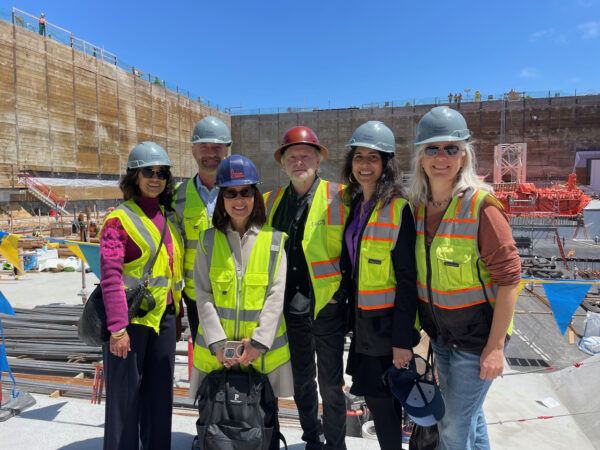
From Left: Anagha Dandekar Clifford, Dan Bernal, Catherine Park, Alan Ashworth, Kavita Mishra, Amiee Alden
Q. Does UCSF anticipate incorporating next-generation accelerator technologies into its research program?
A: Through our collaboration with Hitachi, the UCSF center will feature dose-driven continuous scanning that significantly improves the dose rate and treatment efficiency. We feel these have potential to improve outcomes, especially in patients with lung or thoracic tumors.
Big Picture
Q: If you zoom out, how do you see proton therapy reshaping the field of radiation oncology overall?
A: Although it does not feel so, proton therapy, particularly scanning pencil beam proton therapy is still very new with a relative short history of patient outcome research. The clinical utilization is still being optimized, as well as the patient population which will benefit most is still being determined. UCSF is proud of the historical effort to reshape RT to be more effective and less toxic. In addition, there is further research needed to understand the radiobiologic aspects of proton therapy that are not being optimized. Finally, the way proton therapy works and is delivered is fundamentally different compared to photon therapy and will undoubtedly provide novel paradigms to treatment and ways of thinking about radiation targeting and delivery.
Q: Finally, what excites you most personally about leading UCSF into this next era of cancer treatment?
A: I’m most excited about the many patients that will realize the benefits of proton therapy, will have better outcomes and be spared of many of the toxicities of treatment. These benefits are most obvious for children with cancer but are also predictable for many adults who are facing cancers of the brain, spine, head and neck, lung, gastrointestinal track and genitourinary tumors. Cancer touches so many lives in our communities and families, and once you have been close to the journey, the importance and value of these therapies and discoveries become very real. I am also excited for the new collaborations that having this technology will bring about, and will bring new energy for our younger investigators and clinicians who come to UCSF to make an impact through science and discovery.